Saturday, April 26, 2014

Materials for a better planet

Wired magazine isn't always useful for material science, but every couple of months they publish an outstanding, multi-page or single-page article on the topics.

In the March 2014 issue they provided a one-page summary of four environmentally-friendly building materials.

How to make Magic Mud


Yes, making your own 'Magic Mud' instead of just buying cornstarch and mixing it up sounds like a whole lot of extra work.

Yes, it's certainly cheaper to buy a box of conrstarch than to buy a whole five-pound bag of spuds.

But think of all the hasbrowns you can make (in case there isn't a Waffle House close enough to where you live.)

Honestly, though, I might offer this up as an extra credit opportunity for some of my students.

Friday, April 4, 2014

Metamaterials...a cartoon


Admittedly, today's post isn't anything research-based or anything. It's a webcomic that mentions metamaterials. It's chucklesome but only if you look really closely at the final panel's reveal of the flowers' true colors.

Not surprisingly (if you're a regular xkcd - the source of the comic - reader) metamaterials are real. I need to do more research before I find out whether the effect shown in the comic is possible.

Here's what I've found so far in thirty seconds of research...

Wednesday, March 26, 2014

Kokomo Opalescent Glass factory tour - 3-26-14

It's spring break, and what better way is there to celebrate than by taking a trip three hours northwest to Kokomo, Indiana to tour the Kokomo Opalescent Glass (KOG) factory?

We (Becky and Lonnie) had seen the videos of glass being poured at KOG and even shown them in the summer camps - including at the University of Indianapolis on the south side of Indy, but we had never made the trek to the far north side to see KOG, a world-famous maker of art glass.

The trip is about three hours each way from Cincinnati, but it's an easy enough three hours with the factory being about forty-five minutes north of the loop interstate around Indy but forty-five minutes on a four-lane highway most of the way.

The factory tour only runs once a day - at 10am, so we set off early and arrived at 9:30 as the tour was actually about to get underway. They had a pre-arranged tour of local school children coming in at 10am and wanted to get the day's open tour of a dozen adults moving before the school children came through.

The tour guide (David, far right, first row under The OP Shop Team) was highly knowledgeable, having working at KOG for three years but having worked with glass for more than thirty years. David took us through the hot shop with its twelve kilns (each replaced once every four months or so, the entire kiln shut down and rebuilt once every twenty-five years, glass heated to 2600 degrees [Fahrenheit, David thought]). We got to see the workers pour a few smaller sheets using the catspaw rollers, producing a gorgeous and heavy texture on one side of the 1/8"-thick glass sheets. The sheets were pushed into an annealing, conveyor-belt over for a forty-minute cool time (far shorter than either of us expected). We didn't take long enough to see 'our' sheets come out the other end, sadly.

The next stop was to the glass blowing room where we saw two blown rondels being made and saw the finished products of the glass blowing shop including some gorgeous paperweights. Never knew that the bubbles in the paperweights (like this) were created by rolling the hot glass in baking soda (2 NaHCO3 --> Na2O(s) + 2 CO2(g) + H2O(l)).

We headed to see the large, glass sheets trimmed with impressive efficiency. Sadly 'our' sheets that we'd seen poured weren't quite out of the annealing process for us to see. We did get to see into the 'rainbow room' where many of the glass sheets are stored. We watched some glass beads be made and wrapped up our tour back in the OP shop.

Check out our pics and vids...

Broken glass gets collected by color to be reused.


Saturday, March 8, 2014

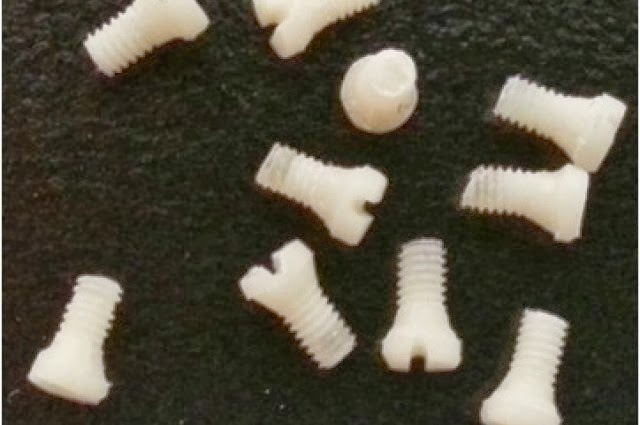
Fix fractured bones with silk screws


I will quote from the linked article on www.iflscience.com (be warned that iflscience stands for I F**king Love Science):
For bones to heal and bond, doctors have been screwing in metal alloys (the gold standard), but compared to the surrounding bone, they’re stiff and unyielding. The stiff implant ends up carrying most of the load, but bones don’t get stronger without physical stress. This phenomenon is called stress shielding, and over time, it leads to bone degradation. Additionally, metal increases infection risk, and its inability to degrade in the body usually means a second operation is needed to remove the pieces. Or worse, if the metal corrodes and has to be taken out before the fracture has even healed.
The article goes on to extol the virtues of silk as a material for medical implants:

Silk has a known low stiffness similar to that of bone -- but it’s tough enough to carve its own threads into bone as it’s screw in. According to Lin, silk materials maintain structural stability under very high temperatures, withstand extreme conditions, and can be readily sterilized.

...

Another advantage to silk: It can stabilize and deliver bioactive component, so these screws "could actually deliver antibiotics to prevent infection, pharmaceuticals to enhance bone regrowth and other therapeutics to support healing.
 Hopefully further tests will continue to show as much promise as the early results have shown.


Xylem from plants can be used to filter water


Sometimes mother nature does it best.

The need for clean, cheap, disease-free drinking water is one of the greatest health needs in the world. Scientists have tried all sorts of materials but invariably run into issues with cost, durability, availability, scaleability, or something along those lines. This article reports on research into using xylem from coniferous trees was able to remove 99.9% of bacteria in samples of water.

It's not an area that we usually discuss in materials science because we're not necessarily building anything from the xylem, but being able to take advantage of a natural material's natural properties is every bit as important as being able to adapt that material for our use.

Thursday, February 27, 2014

Table of Cone Temperatures


When I was in Salt Lake City last summer, I happened upon a small ceramics gallery (Red Kiln Pottery). I was initially looking for some glaze that I had ordered from my Provo supplier sounded a little iffy. At worst, I thought, I would end up with the wrong and the right glaze.

Red Kiln didn't have what I needed but they were able to help me understand the temperature ranges (that we use in our ASM workshops) that correlate to the various cones (that real ceramics folks use to gauge their kiln's temperature). It's a document to which I've referred a number of times, and I thought it might be helpful to share out. 

Thanks, Red Kiln!