Showing posts with label metal. Show all posts

Monday, February 3, 2025

Making an atomic trampoline

I'll admit that I entered the giveaway to hopefully win one of NileRed's atomic trampolines.

No luck, though, so I'll only be able to show the video.

An atomic trampoline is really high on my matsci wish list, though. I want one so desperately.

I certainly watched this NileRed video and came to the conclusion that I'm a lot of money and skills away from making one myself.

Monday, October 14, 2024

Why on Earth is Depleted Uranium Used for Military Ammunition?

Depleted uranium just sounds terrifying. Sure, you can pick up some uranium ore and yellowcake from United Nuclear, but trying to buy depleted uranium is going to likely be a little dodgier.

With that being said, the US military has used depleted uranium (DU) as a source of armor penetrating ammunition over the years. I thought - wrongly from the video above - that the DU was simply used because of its high density and nature otherwise as nuclear waste. Today's video posits that there are quite a few other advantages of DU in high-caliber munitions applications.

There are also some seemingly obvious health risks involved in living in an area where spent DU shells are peppering the ground or having been in a tank where DU rounds entered and as least slightly vaporized. The video also goes through those health risks and says that they have largely been disproven, though I would be skeptical and appreciate that many military branches are "not considering depleted uranium anymore because of the environmental problems associated with it, be [they] real or perceived."

I think I'll stick to good ol' tungsten for my armor piercing needs.

Monday, May 11, 2020

HOW ROCKETS ARE MADE (Rocket Factory Tour - United Launch Alliance) - Smarter Every Day 231


So much to cover here.

The quick version is that Destin (of Smarter Every Day) shows us his tour of United Launch Alliance (ULA with their CEO, Tory Bruno. The ULA factory has some pretty highly-regulated manufacturing going on.

I'll go with a bullet point list of things I found interesting and possibly useful for a material science class. Admittedly, the full video - fifty-four minutes long - is probably more than any class could watch in total, but it's got some awesome clips.
  • 5:15 - The video cuts to avoid filming "that" to Destin's left and right, items that Tory narrates but that he says flatly can't be filmed and shown.
  • 7:15 - Quick discussion of the supply chain for the aluminum sheets that the rocket fuel tanks are made of
  • 8:30 - We see the finished product of a machined isogrid panel as well as why that design - not the ideal design - was chosen because of the limitations of FEA analysis calculations in the 1990s.
  • 9:50 - Discussion of the safety margins in space flight (1.1 - 1.25 times designed load) as compared to those of land-based transportation (7-12 times designed load)
  • 12:15 - Amazingly, we get a mixture of, as Bruno says, "the pinnacle of technology...high-tech, robotic operations but mixed in [with] craftsmanship with people who are very skilled and have great attention to detail." That's amazing that something this precise is partially done by hand. This will come back in a bit.
  • 13:30 - Machining, subtractive manufacturing is mentioned...as well as their recovery system for recapturing the aluminum chips for eventual recycling.
  • 17:00 - 19:20 - Advertisement for Audible, skip it
  • 19:30 - Replacing the isogrid with an orthogrid, saving time and weight, along with a quick discussion of strain and work hardening that happens by hand after the machining. We get a nice close-up of the orthogrid at 21:10.
  • 22:00 - Destin uses the term strongback to describe the construction of the press used to curve the machined panels. That's a term I had to look up.
  • 22:45 - Destin questions whether the aluminum is annealed, and Tory says they allow the aluminum to artificially age at room temperature after they are slightly work hardened from the curving process.
  • 24:15 - Back to manual manufacturing to a precision level that - according to Tory - can't be achieved by automation. "You will always get better results by doing it by hand," he says.
  • 27:30 - We see the anodizing facility to create a thick oxide layer for hardness and corrosion resistance. I knew that bare aluminum automatically formed an oxide layer, but I hadn't heard - as Tory says around 28:10 - that the natural layer is very thing and porous, leading to poor corrosion resistance.
  • 31:30 - I wonder what the various acid concentrations are.
  • 32:10 - We head toward the friction stir welding area, and Tory explains why friction stir welding is the better choice for strength of their final tank.
  • 34:05 - Destin 'peaks over there' at a highly pixelated area. Cute
  • 36:00 - Quick explanation of why it's better to order one large pizza than to order two medium pizzas
  • 37:40 - Another pixelated section with the specialized head of the friction stir welder
  • 40:15 - We switch over to stainless steel - half the thickness of a dime - instead of aluminum as we switch from boosters to upper stages. 
  • 43:00 - We get a finished view of the 5m composite payload faring and a discussion of ULA having brought the manufacturing of that from Switzerland to north Alabama via business partnership.
  • 44:00 - Bruno discusses ULA's record of flying both payload and actual people successfully with 135+ consecutive, successful launches. 
  • 45:20 - Discussion of mass fraction (without explanation)...I had to look that up, too.
  • 46:30 - Changes coming from hand arc welding to automated welding in the next version of Centaur (the upper stage) to save time (and assumedly cost).
  • 47:40 - We get a quick glance of the team of people who are walking around behind the scenes with Destin and Tory. Admittedly, it looks like Tory is taking Destin around solo, but there are clearly people supervising even the CEO the whole time.
In general, I'm incredibly impressed with Bruno's knowledge of the entire process. It's amazing to see that from a CEO. Maybe that's the way that all CEOs are, but I doubt it.

And, if you want even more, there's a second video - on Destin's second channel - where the guys get into some discussion about the rocket engines themselves and ULA's position within the industry. It's less materials-focused, but it's worth watching.

Sunday, October 16, 2016

The Composition of US Coins

Thanks, Compound Interest.

And thanks, ACS for working with Andy Brunning (of the aforementioned Compound Interest) to produce this great, visual guide to the metals in US coinage.

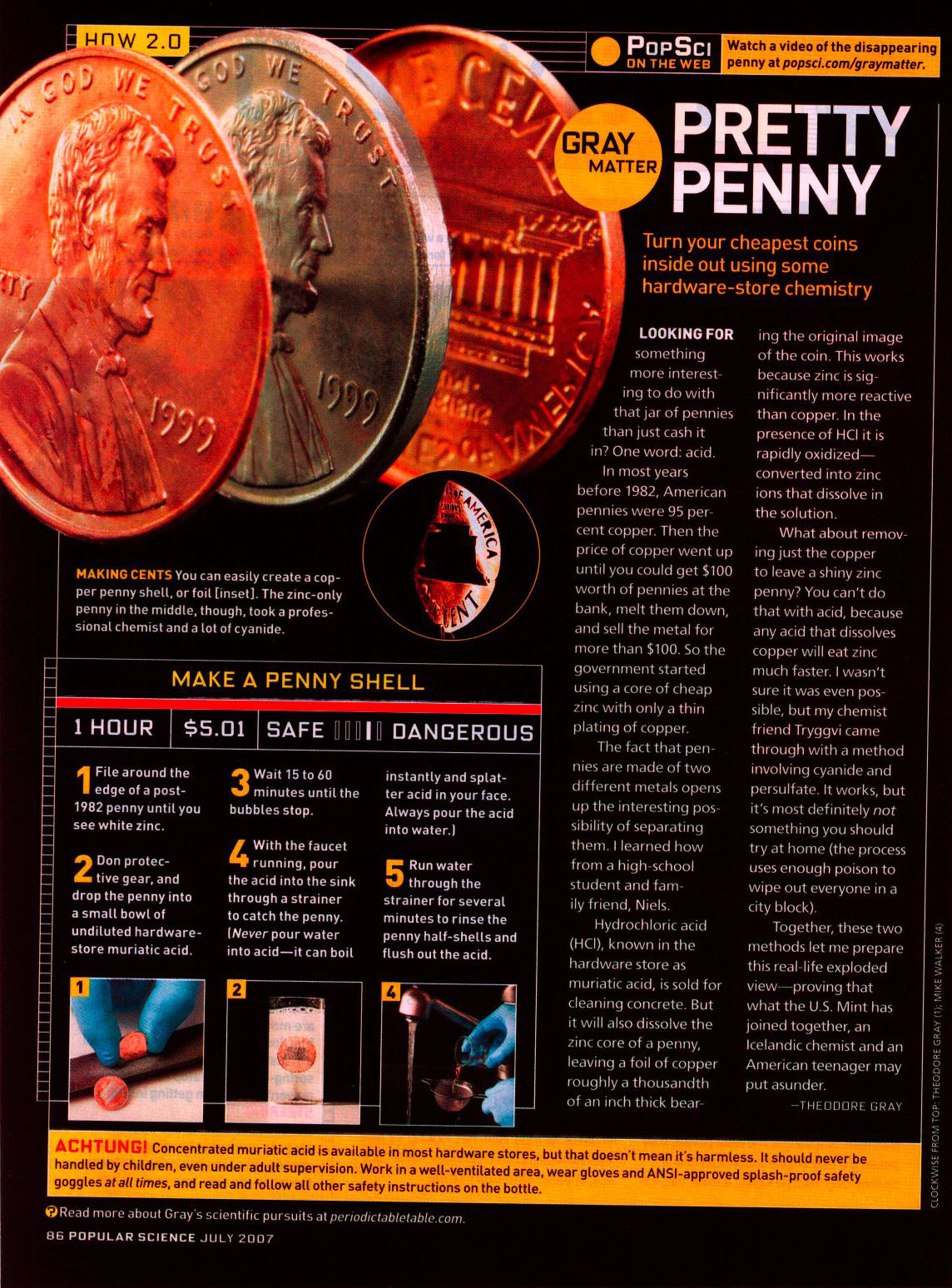
That non-pure copper penny can make for some great lab experiments.

Then again, so can the pure copper.

Sunday, June 5, 2016

Boeing says it created lightest metal ever


Apparently strong, lightweight materials matter when building airplanes?

Either that or the Boeing engineers just want to dominate their kids' egg drop challenges at school.

From a cnn.com article about the microlattice...
The microlattice weighs only about one tenth as much as carbon fiber, and is actually slightly lighter than air itself, said Bill Carter, the director of the Sensors and Materials Laboratory at HRL.

It will likely first be used on space rockets that Boeing plans to build in about five years, and it should make its way into commercial planes about five years after that, said Carter. He said the cost of manufacturing will have to come down a little more before it is economically feasible to use on cars.

Sunday, May 1, 2016

Color: a spectrum of possibilities for your ring


I desperately want a titanium ring, and I'm really curious to get one that's anodized in some gorgeous color(s).

I just can't figure out which ring I want. There are tons of choices.

The titanium, then, can be oxidized to produce gorgeous colors. The process of creating an oxide coating on a metal via application of electrical current is called anodizing.

One of these years I'll get around to trying to do some anodizing myself, but I'm going to have to get a steady supply of titanium before I can use it as a class lab. Titanium's kinda expensive and really, really hard to cut - something that I need to consider, too.

When I do get around to it, though, I'll check back on these instruction pages.

As a warning, there isn't really any color to the oxide layer. It's caused by light wave interference. Check the science out if you really want to know.

If you were thinking of a gift for your favorite material science blogger, I'll need to measure my ring size first, but this one's the current choice.