Thursday, January 26, 2017

King Tutankhamun's Dagger Was Literally Out Of This World

"That’s right: King Tut had a space dagger."

How cool is that?

An article published in May in the journal Meteoritics and Space Science is titled "The meteoritic origin of Tutankhamun's iron dagger blade".

In the article (sadly behind a paywall but detailed at IFLScience) scientists recount the process of using x-ray fluoroscopy to determine the precise elemental composition of the dagger's blade without any harm to the blade itself.

The scientists were even able to determine the exact meteorite from which the dagger was forged nearly 700 years ago.

Science is stunning.

Saturday, January 21, 2017

Rare glass penny from World War II sells for $70K

Who knew?

I'd heard of the steel pennies from 1943. Heck I've had one somewhere along the way (though I've no idea where it is right now.)

But a glass penny, experimental or otherwise?

That's really cool.
During the war, copper was needed for ammunition. The U.S. Mint authorized tests that included making uncirculated pennies from other metals, plastic and rubber. The Blue Ridge Glass Co. in Tennessee made experimental pennies using tempered glass. (source)

Saturday, January 7, 2017

Wooden Laboratory - Periodic Table of Videos


Just about every single thing that we do damages the environment.

At the very least - even if we go as neutral and non-pejorative with that idea as we can - everything that we do changes the environment.

Bit by bit we're figuring out that we can't keep doing that with every building that we erect.

Here's a great video of how the University of Nottingham planned out their most environmentally-friendly laboratory building yet.

They used as little steel and cement as they could, made sure their systems were efficient, brought in natural light wherever they could, included photovoltaics with the windows, and tried to find a way to 'do science in a fundamentally different way.'

Separately, I recommend checking out the entire YouTube channel of Periodic Videos from the University of Nottingham. It's more chemistry than it is material science, but it's fun stuff.

Wednesday, January 4, 2017

HYPNOTIC Video Inside Extreme Forging Factory: Kihlbergs Stal AB Hammer Forging


I don't know that the video is hypnotic. That's overselling things.

It is, however, impressive to watch the forging that's being done here. I'm especially impressed with how much of the forging is done by hand, the pieces moved, rotated, shifted, pierced - all by hand.

Does anybody know the name of the tool used for the notching done at 2:55? Is it a notcher? A notching tool? A notch? A wedge? A notch wedge? Wedge notch? Triangular wedge notching tool? Notch wedge triangular prism with metal handle?

Saturday, December 31, 2016

Material Properties 101


The narrator's Irish accent, tho...

The introduction to the video says there are six terms that he's hoping we understand by the end of the video...
  • stiff
  • strong
  • ductile
  • brittle
  • tough
  • hard
Man, if all of my students understood those terms by the end of the semester, I'd be thrilled.

We get coverage of a tensile test to explain stress, strain, and the stress-strain curve (along with many of its aspects - yield strength, ultimate strength, Young's modulus, fracture, tensile strength, max allowable load/stress, toughness).

He then covers hardness briefly, explaining how the Rockwell hardness test works.

It's not perfect because it left me wanting to know more...but maybe that's the point.

The entire video is six minutes long, and the last forty-five seconds or so is an advertisement for the video's sponsor - annoying but still school appropriate, thankfully.

Friday, December 9, 2016

Polymer Ambassadors & POLYED

Just last week I was at NSTA's regional conference in Columbus, OH, and I came back with a few things I thought I should mention.


First, go to an NSTA conference. They're outstanding. Admittedly, the regional conferences are smaller versions of the glorious, massive, national confernces, but that's still a pretty outstanding version. Yes, the ASM folks tend to present, but I'm all good with seeing them and continue to learn new things every time. Do yourself a favor and avoid most of the exhibitor workshops because they tend to be extended sales pitches (unless you already have a relationship with the company and know that they don't do as much selling as they do teaching.) And, check out the ASM folks (Debbie Goodwin, Andy Nydam, Scott Spoller, Caryn Jackson, Sherri Rukes) while you're there because their presentations are contistently outstanding. On the personal side of things, I can say that it was a regional NSTA presentation from Debbie and Andy that got me involved with the material science program.


Secondly, at her presentation (lotions, potions, and scrubs), Sherri mentioned two resources. The first is the Polymer Ambassadors website (available but currently undergoing a much needed redesign behind the scenes) with its excellent activity sheets and links to the PolyEd Award, a grant to fund and reward polymer education in the schools. The current application information lists only an award for middle and high school teachers who teach about polymers in the classroom, but Sherri mentioned that this year's awards will now have separate competitions for elementary, middle, and high school teachers.

The grants pay $1000 per teacher - directly to the teacher - for, I guess, supplies to keep teaching about polymers, though the payment comes to the teacher not to the school district. Plus the winner gets funds paid to go to a national NSTA conference. The application process isn't very involved, and Sherri has said that in a number of years they give out a half dozen awards with fewer than a half dozen applicants.

That means you're likely to win the award if you apply.

So, what's stopping you?

You teach about polymers, right?

Whether it's two-part Eurocast and shrinky dinks or bioplastics, that's teaching about polymers.

Apply!

Sunday, October 16, 2016

The Composition of US Coins

Thanks, Compound Interest.

And thanks, ACS for working with Andy Brunning (of the aforementioned Compound Interest) to produce this great, visual guide to the metals in US coinage.

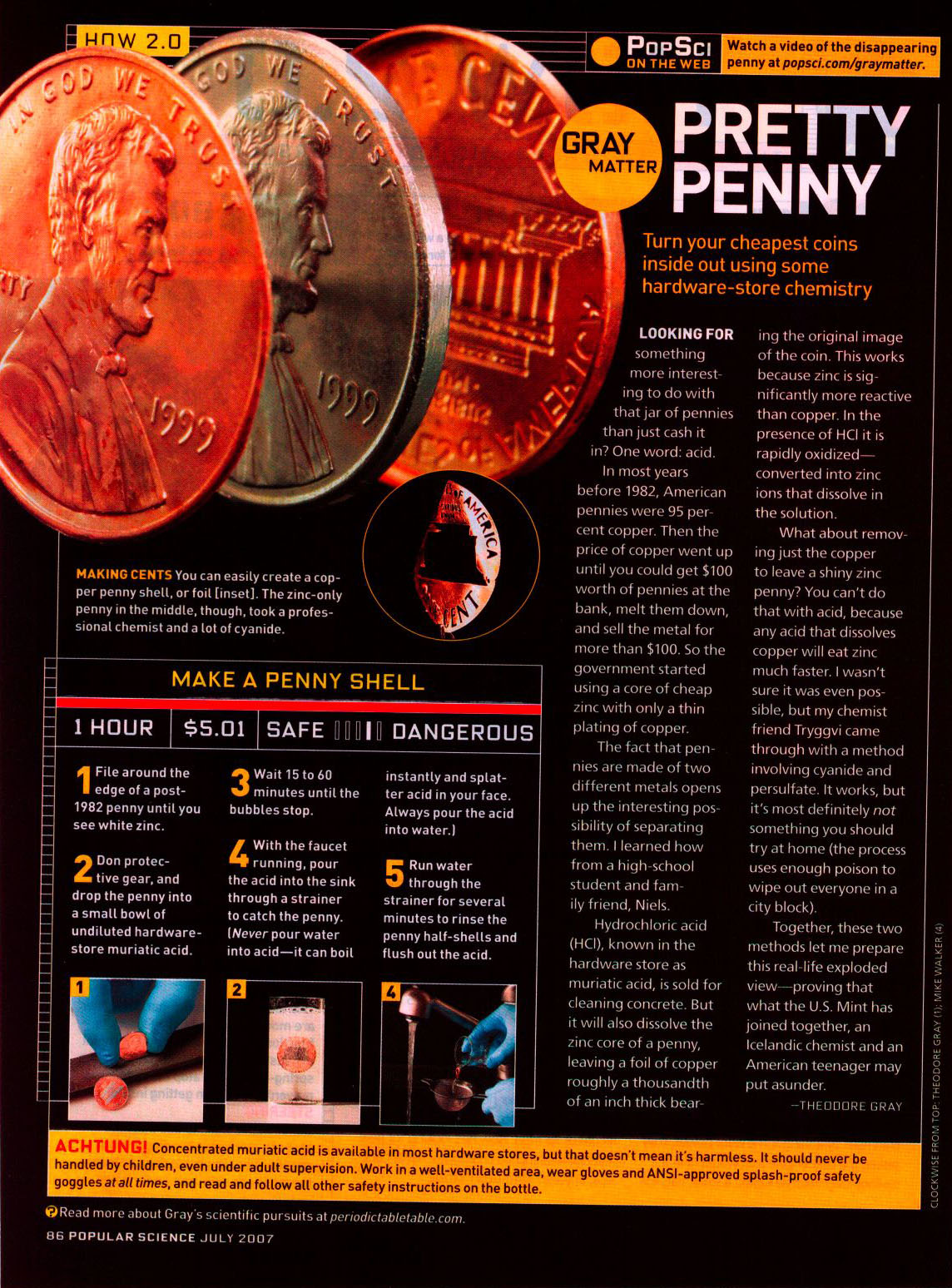
That non-pure copper penny can make for some great lab experiments.

Then again, so can the pure copper.