Showing posts with label aluminum. Show all posts

Monday, April 29, 2024

Liquid Metal Embrittlement - Gallium vs. Aluminium

"Well, contrary to what you might think, it's not a chemical reaction." ~ 2:17

I'll readily admit that I assumed it was based on a chemical reaction rather than what this video suggests - just after the above quote - the gallium seeps into the grain boundaries between the aluminum crystals and prevents them from holding together as they normally would.

Embrittlement, eh?

Monday, January 2, 2023

Afraid of heights? This is not the job for you | SciTech Now

As opposed to last week's less-then-professional-sounding narrator, this week's video host sounds like he belongs on local television reading the news or interviewing a woman who lost her cat.

He does, however, tell an interesting story of people climbing St Louis's Gateway Arch - one of my favorite places in the world, honestly - to figure out what was causing some staining on the underside of the Arch. One concern was the possibility of damage or corrosion on the surface of the arch.

Luckily, the exploration found that the stains are superficial...and they decided not to clean the Arch - as of the time of this video in 2016.

Monday, March 15, 2021

The secret of the aluminum can: what is it hiding?

That's some impressive can polishing right there.

This video from MEL Chemistry shows how to reveal the secret polymer liner that lives inside every pop can (or Coke can if you're from Southern Indiana like your friendly neighborhood blogger is) using 'drain cleaner.' I assume it's something like Drano, a very concentrated solution of primarily sodium hydroxide. 

I do this experiment in class using hydrochloric acid in the 3M range, and it works just fine. Aluminum is, however, soluble in both acids and bases (not typical of most metals), so I have heard that sodium hydroxide solutions can produce the same result. 

I would certainly be careful with the 'drain cleaner', folks, because it's some nasty stuff. Weirdly, I'm more comfortable using 3M HCl because it's something I use with fair regularity at school. The Drano, however, gives me a bit of an uneasy feeling. Oddly, though, Steve Spangler's video of the same demo also uses sodium hydroxide as did most of the other videos I found showing this demonstration. That might be because buying hydrochloric acid can be a bit tougher (unless you know it's also called muriatic acid and is available at most hardware stores.)

Either way, be careful if you try this at home, but it's pretty frickin' awesome to see.

Monday, December 7, 2020

Aluminum =/= aluminium

When I was a college student at the University of Aberdeen (I spent my junior year from Wabash overseas in Scotland, doncha know) I was admonished by one of my professors for misspelling the element aluminum. 

See, he didn't know I was an American, and I didn't know - at the time - that the Brits spelled aluminum with an extra i - aluminium.

So, just why do we spell that element differently than they do?

For a few years now I've been telling a story of the Aluminum Company of America (Alcoa) changing the name because it sounded better in their advertising back in the 1880's.

The story that Michael Quinion tells in his book Port Out, Starboard Home about the etymology of words and phrases in the English language is somewhat similar to that but isn't quite the same.

Check out the story in his book - or on Google Books here.

Monday, April 13, 2020

How It's made - Aluminum cans


The top comment on the video (at least when I checked in on it) said the following "I watched this whole video to see how the pull tabs were assembled on the top of the can–sincerely disappointed."

So, I'll warn you in advance that this video stops with the cans assembled - except for the top of the can being attached, something that happens after the can is filled with liquid. If that means you don't want to watch the video, move along.

The main reason I watched the video was to find out how the polymer liner is put into the can. Thankfully, that part was included - the polymer liner is sprayed in as a 'varnish' (but take that with a grain of salt because the whole video uses British language such as aluminIum) at about 3:40.

Monday, August 5, 2019

Transparent Aluminum - Star Trek Technology is now Real


Wait, if the material is actually a mixture of aluminum, oxygen, and nitrogen - "also known as Alon" (about which I've posted before)- then it's really a ceramic not a metal at all.

I feel a little mislead by this obvious click-bait title.

Monday, December 24, 2018

Making aluminum without making CO2


At this point, jainism is starting to look pretty good to me.

The basic summary - if I'm in a charitable mood - that I've come to about our environmental impact is that everything we do changes the environment. If I'm feeling a little less neutral, it's more that everything we do harms the environment.

Yes, the aluminum industry's carbon dioxide emissions are - from the graphic above (source) - far less than those of the iron & steel industry, cement manufacturing, or - by leaps, bounds, and a broken scale - our consumption of fossil fuels. And, according to the Aluminum Association's website, "Energy demand to produce new (primary) aluminum is down more than a quarter since 1995 and the industry's carbon footprint is down nearly 40 percent." That doesn't, however, remotely mean that the carbon dioxide released by the aluminum industry is negligible.

A recent article from C&EN, highlighted one of the industry's further efforts to reduce CO2 emission by developing more and more inert anodes instead of the current, carbon-rich anodes which produce CO2 - and CF4 and C2H6 gases, also potent greenhouse gases - throughout the aluminum production. In fact, Alcoa and Rio Tinto have formed a new venture, Elysis, to develop and market these anodes.

For two years, Alcoa has been offering a premium, sustainable aluminum line guaranteeing that the aluminum produced creates 75% fewer CO2 emission than the industry average.

All of these are among many industry efforts to reduce CO2 emissions and environmental impact - within all industries, honestly, not just aluminum. As a presentation titled "Can the global aluminum industry achieve carbon neutrality" writes, "we didn't inherit aluminum from our parents. We are borrowing aluminum from our children."

Source - link

Monday, November 12, 2018

Aluminum recycling - How it works by Norsk Hydro


We have to recycle more.

There are many countries that are far, far better at recycling than is the US, but we (the US) have to get better.

I hadn't thought about the challenge of not just sorting the majority metals (steel from aluminum from copper from etc) but rather sorting the various similar metal alloys out from each other. The use of x-ray spectroscopy to do that is an application that I would never have considered, and the puff of air used to fire away the unacceptable aluminum alloy chips is amazingly fast.

It's amazing to me how technologically advanced the recycling industry is becoming.

Tuesday, October 4, 2016

Aluminum - the material that changed the world


Trigger warning - the narrator here has an Irish accent (I think) which could lead some folks to being distracted because it's that cool.

Oh, and they misspell and mispronounce the element being discussed.

Of course, the aluminum being discussed is a stunning material, lightweight, self-protective, and - if heat treated correctly (as described at 1:40) incredibly strong.

Then, at 2:30 or so, the video gets into age hardening of aluminum, and the video becomes way better.

We get images of FCC at 3:00...slip planes at 3:25...alloys at 3:45 (with great imaging of the atoms)...

This is an outstanding video here.

Thanks to Debbie (and her Philly campers) for sending this my way.

Sunday, June 19, 2016

This is pure snow! It's everywhere! Do you have any idea what the street value of this mountain is?


So, the gag and some background.

XKCD is a webcomic. It's geeky and typically pretty outstanding. Sometimes, however, it's even better than that. Ever now and again Randall Munroe, XKCD's creator, expands the boundaries of the stories that he wants to tell, pushing beyond the limits of the standard three- or four-panel webcomic format.

In comic 1608, a glimpse of which is shown above, Randall published what looked like a single panel, coin-gathering game with the lead character on a hoverboard. If the player, however, ignored the 'rules' and headed outside of the game board, the world became much more interesting, including references to dozens of other XKCD strips, Star Wars movies, Lord of the Rings, and lots, lots more.

Somewhere to the left of the origin area was a Washington Monument, 'climeable' with your avatar's hoverboard. At the top of the monument was the scene shown above, with two characters climbing the Monument with conventional ropes and one of them commenting that the top of the Monument is solid aluminum, and they're going to be rich.

See, I get that because of my material science time and learning. I've posted about the Washington Monument's cap before, and the aluminum cap certainly would've been enough aluminum to make any man rich - when it was first installed.

I, as always, recommend XKCD in its entirety (though there are occasional NSFW moments). There's also a parallel website called ExplainXKCD.com for when you (or I) don't get the gags. You can also get a full-comic image of 1608 on ExplainXKCD, too.

The post title is also a gag for those of you in the know.

Sunday, December 20, 2015

Molten Aluminum vs 'Spitballs' - SO COOL!! (water balz)


I'm starting to recognize that the danger in molten metal coming into contact with water is when there's a small amount of water.

That small amount of water can gain enough energy to boil which spits the molten metal into the air.

Dump the same molten metal into enough water that the water can't all boil, however, and some cool stuff can happen.

Sunday, September 6, 2015

The Point of a Monument: A History of the Aluminum Cap of the Washington Monument


The Washington Monument was capped with aluminum in 1884 because aluminum was among the most valuable metals at the time, and the use of aluminum as an apex for the monument was a way for the United States to demonstrate its material science and industrial primacy in the world.

At least that's the story I tell in my material science class and in my summer workshops.

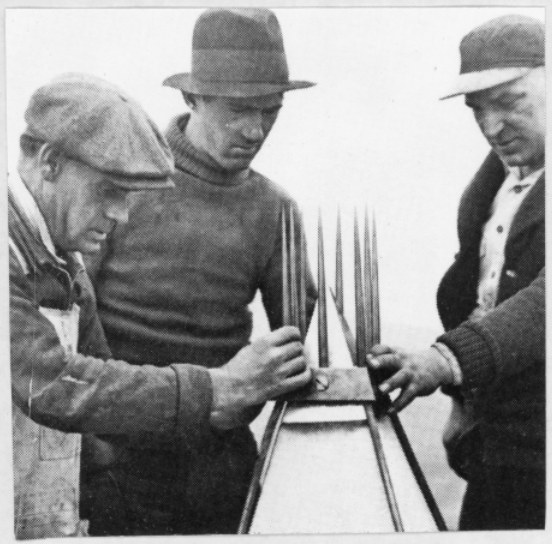
George Binczewski, however, tells a different story in his article "The Point of a Monument: A History of the Aluminum Cap of the Washington Monument." In the article, Binczewski recounts the story of how aluminum was chosen, cast, and subsequently refurbished. Apparently aluminum was not the first choice, and material selection had more to do with use as a point to the lightning protection system.

That isn't nearly as exciting a story as the mic drop version of material science. "We have aluminum. You don't. Deal with it, punks. US out."

Sadly, though, it just might be truer. I'm going to have to adjust my patter again.

By the way, you can check out the aluminum apex actually looks - as of the Monument's 2013, post-earthquake check-up, anyway - in this pic (source: Wikipedia).


And here's a look at the most metal version of the apex in its era of having a copper jacket (visible just above at the base of the apex) but without its temporary copper spikes to further its job as a lightning rod. (Source: Phillip C Marshall)


Pic up top is from Red Ice Creations.

Friday, July 31, 2015

10 mind-blowing man-made materials


Admit it, you're every bit as susceptible to list videos (and internet posts) as I am.

We all must be, otherwise we'd probably lose a third of the internet and be left with just cat videos and pictures of pretty people.

This video is severely lacking in detail for each of the "ten mind-blowing man-made materials", but it would be a great starting point to get your class thinking about the Materials Choice Award.

How to make the mini metal foundry


There's pretty much nothing better than melting metal in the backyard (or maybe on the patio, wouldn't want to set the dry grass on fire out there, folks). And aluminum isn't a bad choice since it has a relatively low melting point for a metal.

Plus, lots of us have ready supplies of aluminum just sitting around in the recycling bin (because we wouldn't ever throw an aluminum can away, would we?)

In this trilogy of videos, the King of Random shows us how to make a backyard foundry, melt and purify aluminum, and then cast something via lost foamboard casting.

Looks like a blast.


Tuesday, June 30, 2015

Pinkbike vists the Santa Cruz Test Lab Video

Edit: Looks like the video has been taken down from YouTube. It's still available (but not embedable sadly) on this webpage which includes a lot of analysis of the tests.

break it!

Break it!

BREAK IT!

Joe Graney might want to talk to somebody about how to look like he's actually enjoying his hosting duties, because he's lucky enough to be standing there and breaking the snot out of both aluminum and carbon fiber bike frames (with a screw drive at 0:47 and then with dropped weights at 2:45).

Interestingly, the sudden breaks (from dropped weights) don't look all that different, but the slow breaks look very different.

Thanks, by the way, to Frank Marks, Director of Engineering for Utah Test and Training Range, who showed this at our graduation in Salt Lake City last week.

Sunday, April 19, 2015

The ingeneous design of the aluminum beverage can


Holy crap is the aluminum can complicated.

Maybe I should stop throwing them into the back of m'pick up truck and just letting them blow away into the coutryside.

Seriously, though, the aluminum can is - as are so many of our modern technologies - an absolute marvel of engineering. The number of steps involved in turning a 0.3"-thick aluminum disk into the finished can is stunning. Also stunning, by the way, are the examples that The Engineering Guy has along every step of the process. I'm desperately curious - and more than a little envious - as to how he got his hands on all of those.

After the jump I'll include all the videos he references at the end of the above video.


Sunday, March 15, 2015

Apple Watch (various materials)


That is a straight up gorgeous piece of film making and advertising.

The sights of the aluminum being forged, poured, machined, anodized, and finished are absolutely stunning. Go watch it again before you start looking at the science of what's happening.

We get the full gamut of processing (forging, machining) and materials (metals, alloys, ceramic - zirconia - beads for the finish).

Beautiful...

And that doesn't even being to touch on the gold and steel videos that I'm putting after the jump.

All of these are available on Apple's watch craftsmanship webpage along with text and photos of the zirconia chosen for the crystal covers, the ion-x glass for the Sport face (potassium ion soaked to increase strength), or the sapphire facing for the Watch and Watch Edition editions (that sounds incredibly stupid to read).

There is also a webpage from Atomic Delights (a blog with sadly only three posts in two years - better quality than quantity, I guess) that does a far better job breaking down the three videos and speculating on some of the science therein than I ever could.

Saturday, November 1, 2014

Blogging the Periodic Table: Aluminum - it used to be more precious than gold


Slate has put together a series called Blogging the Periodic Table written by Sam Kean (of the awesome The Disappearing Spoon). They're up to thirty-three articles so far. The last was published in June, 2011, so I'm assuming that thirty-three is where the series is going to end.

Aluminum, as the article relates, is the most common element in the Earth's crust was absolutely useless to us for centuries because it is so reactive. As the article writes...
From a world production total of perhaps a few ounces per month in the decades before, by 1888, the largest U.S. aluminum company (the one that became Alcoa) could produce almost 50 pounds of aluminum each day. Within 20 years, it had to ship out 88,000 pounds per day to meet demand. As production soared, prices plummeted. In the mid-1800s, the first aluminum ingots on the market went for $550 per pound. Fifty years later, not even adjusting for inflation, it cost 25 cents for the same amount.
Check the article out. If you enjoy it, check out Kean's Disappearing Spoon, an absolute masterpiece of chemistry, material science, and story telling.

My Lab Rats: Quick and EZ Defrost Tray Review

I have a MiracleThaw (or a knock-off that Tom picked up for me from a thrift store) that I demonstrate in class. It makes for a cool demonstration to show that the aluminum does a spectacular job of transferring heat to the ice and melting the ice far more quickly than students would expect - especially after they touch the MiracleThaw first and find that it feels absolutely cold in spite of it being firmly at room temperature. I also have a pair of Flinn Scientific's ice melting blocks which make for a nice comparison

Check out another couple of articles about the MiracleThaw that come in pretty digestible, bite-sized servings for you and your students...

Sunday, August 10, 2014

How It's Made Aluminum


And so goes the glory of Napoleon's really fancy knives and forks...

This video, from the How It's Made series, shows the process necessary to purify bauxite ore into useful, 'finished' aluminum.

Sadly, though, it is bereft of the corny joke that usually comes at the beginning of the How It's Made videos. I kind of miss the joke. Does that mean I've got Stockholm syndrome at this point?