Showing posts with label medical. Show all posts

Monday, April 19, 2021

Quicksilver and Slow Death


Source - "Quicksilver and Slow Death" - National Geographic, October 1972

I'm just going to let that picture sit there for a moment.

Feel free to scroll down once you've absorbed the fascination, curiosity, intrigue, and abject terror of the sight of a man sitting on a pool of mercury with seemingly no protective equipment at all.


I'll wait.


That's the picture that sent me down a rabbit hole a few years back. I came across the photo somewhere - I've no clue where other than 'on the internet' - and wanted to track down its origins. Who took that? Where were they? Why were they sitting on mercury? When the heck was it taken?

Eventually I came across a source saying that the image came from National Geographic's October 1972 issue in the article "Quicksilver and Slow Death".

At the time, hunting down the article with images was fairly difficult as I hadn't found full text scans of articles in library databases just yet.

So I headed to ebay and spent about $6 buying a copy of the magazine so I could read the original article.

It turned out to be fascinating.

Here's the original caption for the photo.

Floating on mercury, a veteran miner demonstrates the metal's high density - 13.5 times that of water. Mercury's great cohesiveness prevents it from wetting skin or clothes. Being liquid, however, it penetrates the finest crevices. Once out of the vat, the man turned out his pockets and shed his showed to shake out droplets of theś metal.

The article surveys the historical ideas of mercury...

Arabian and European alchemists deemed mercury one of the two "contraries" (the other was sulphur) that combined deep in the earth to form all other elements.

...the health hazards of mining mercury...

In one room [of the miner's hospital] the walls were lined with powerful lamps, the floor marked with a circular path. "The miners call this the 'beach,' " Don Jeśus told me. "Sometimes a man inhales too much mercury vapor in the mine and develops a tremor. If it's a sever case, the doctors send him here for treatment.

"He strips and walks round and round in the heat, sweating out the mercury. Most respond rapidly and are returned to work. A few don't; they are pensioned."

...and the health hazards of exposure to mercury, particularly from eating contaminated fish, pork, or grain...

Borne by the bloodstream, methyl mercury penetrates brain membranes that bar most other poisons. First, it damages the organ without appreciable loss of cells, then erodes whole pockets of tissue. Worst hit are the brain's visual, hearing, and equilibrium centers, thus explaining the effects of mercury poisoning - blindness, deafness, and loss of balance.

The article closes with this warning, from Dr Alf Johnels, 

"It was a matter of human failure. We cannot see beyond immediate needs: Mercury did the job, so we used it and trusted the earth to absorb in. Not until people and birds died did we find out how wrong we were.

"If mercury were the only pollutant, that would be one thing. But every day we're pouring into our environment tons of other substances - cadmium, lead, industrial chemical like the polychlorinated biphenyls called PCB's. Some are stable and will be with us a long time. And we have no idea what their long-term effect will be.

"We who work in museums know about vanishing species - they are here, as always, then one dat they are gone. Their environment has changed.

"Only if we think in terms of generations, and are willing to pay the price of keeping the world clean of our our foulings, can we have confidence that man will not join that list of vanishing species."

If you want to read the full article - it's dated but outstanding - here it is in full.

"Quicksilver and Slow Death" - NatGo - Oct 1972 by phschemguy on Scribd

Monday, April 12, 2021

Nanotechnology is not simply about making things smaller | Noushin Nasiri | TEDxMacquarieUniversity


The scale of nanotechnology befuddles me, but this video focuses more on why the nanoscale matters than it does on 'hey, here's some neat nanoscale stuff'. Yes, there's some neat nanoscale material mentioned toward the end, but the better part of the video for me is the clean, clear progression from 'what is the nanoscale' to 'why does the nanoscale matter' to 'what can we do in the nanoscale'.

Well done, Dr Nasiri.

Sunday, February 19, 2017

Adding A Funny Form Of Carbon To Silly Putty Creates A Heart Monitor


Silly putty is apparently miraculous.

It doesn't walk down stairs - along or in pairs. It doesn't roll over your neighbor's dog.

But it does appear to be usable as a pressure sensor when graphene is added to it. The graphene turns the silly putty into a conductive mass, the precise conductivity of which is highly sensitive to changes in pressure - to the point where it can be used to monitor the blood pressure and pulse in the carotid artery.

Source - NPR and Science

Sunday, February 5, 2017

This gel stops bleeding in seconds


Oh, by the way, the video above shows blood.

You know, in case you were queasy about blood or anything...

There are going to be a couple of other blood-centric videos after the jump in a few lines.

The idea that a seventeen-year-old student took algae and developed a blood-stopping polymer makes me think I should probably be doing labs a little more involved with my chemistry students. Sheesh...

Honestly, though, the video up above shows the gel as vetigel, but it's now available as traumagel.


Sunday, September 20, 2015

Cancer patient receives 3D printed ribs in world's first surgery


Sure, it's cute enough to print intricate rooks in metal, but it's not like you're exactly saving lives there.

Printing a rib cage for a patient who's about to lose his to bone cancer, though? That's a frickin' miracle.

And that's clearly something that would never be feasible on a large production scale because every rib cage is going to be differently sized, differently shaped, differently damaged.

We live in amazing times, folks...amazing.

Monday, September 7, 2015

A new type of bandage will draw out bacteria and speed healing

Personally, I like the bacon bandages available from Archie McPhee. I will warn you, however - and this comes from someone who has bought a full box of those bandage tins - that their sterile wrapping isn't as well made as are the name-brand Band Aids. If you leave the bacon bandages for a few years, the wrapping comes apart.

I'm thinking, though, that any bandages made out of the material from this article will be of slightly higher quality than were those bacon bandages.


The basics - including the graphic above from the ACS-published article - are that...
[t]he nanofibre mesh is created using a technique called electrospinning, in which polymer filaments 100 times thinner than a human hair are squeezed out of an electrified nozzle.

The resulting fibre is then coated in compound called allylamine, which Abrigo has found makes a range of different bacteria quickly attach to it.
The bandages have been tested on liquid media and directly onto agar plates but not yet on actual wounds.

From the ACS abstract - and possibly most interesting from a material perspective, "[f]iber diameter was shown to affect the ability of bacteria to proliferate within the fibrous networks, depending on cell size and shape. The highest proliferation rates occurred when fiber diameter was close to the bacterial size. Nanofibers were found to induce conformational changes of rod shaped bacteria, limiting the colonization process and inducing cell death. The data suggest that simply tuning the morphological properties of electrospun fibers may be one strategy used to control biofilm formation within wound dressings."

How cool...

Monday, August 17, 2015

'Smart implants' dissolve after healing - Science Nation


I don't get what's so impressive. I implant ice cream directly into my body with some frequency, and my body takes care of that all the time.

Too much ice cream, actually...

I'm hoping that they take any magnesium implants out of the bodies before they get cremated... sheesh.

That would be pretty cool, though, if medical implants could be absorbed into the body after the structural support is necessary.

Tuesday, December 2, 2014

Superfast clotting agent could save many lives


I have to admit that I found this story from the not-school-appropriately-named I F*&(ing Love Science website. It's honestly way more entertaining and informative than I want it to be because I can't ever share these links on my class Facebook page - which I hate.

That's I hate not being able to share the links.

Not that I hate my class Facebook page. I don't. I actually like it a fair bit.

The video shows an in-development product designed to clot blood nearly instantly. It's apparently a polymer made of plant-derived polymers extracted from plant cell walls - like Lego blocks according to the company's co-founder and CEO.

Saturday, March 8, 2014

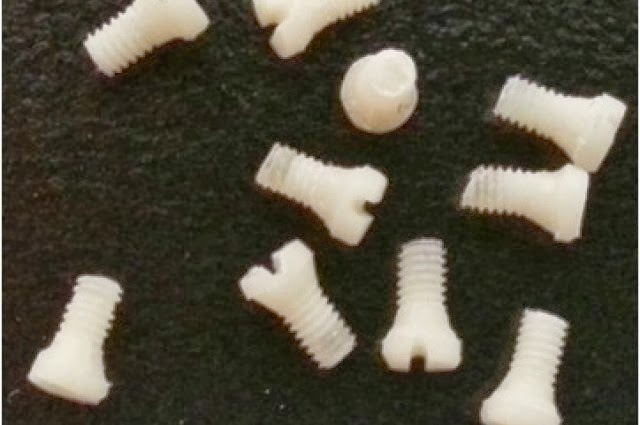
Fix fractured bones with silk screws


I will quote from the linked article on www.iflscience.com (be warned that iflscience stands for I F**king Love Science):
For bones to heal and bond, doctors have been screwing in metal alloys (the gold standard), but compared to the surrounding bone, they’re stiff and unyielding. The stiff implant ends up carrying most of the load, but bones don’t get stronger without physical stress. This phenomenon is called stress shielding, and over time, it leads to bone degradation. Additionally, metal increases infection risk, and its inability to degrade in the body usually means a second operation is needed to remove the pieces. Or worse, if the metal corrodes and has to be taken out before the fracture has even healed.
The article goes on to extol the virtues of silk as a material for medical implants:

Silk has a known low stiffness similar to that of bone -- but it’s tough enough to carve its own threads into bone as it’s screw in. According to Lin, silk materials maintain structural stability under very high temperatures, withstand extreme conditions, and can be readily sterilized.

...

Another advantage to silk: It can stabilize and deliver bioactive component, so these screws "could actually deliver antibiotics to prevent infection, pharmaceuticals to enhance bone regrowth and other therapeutics to support healing.
 Hopefully further tests will continue to show as much promise as the early results have shown.


Wednesday, May 1, 2013

What is ANGIOPLASTY and STENTING?


I'm guessing percutaneous coronary intervention is a phrase that is just casually thrown around in some medical fields, but it seems a pretty daunting introduction to me. The animation shows how balloons and stents - assumedly made of memory metal - are used to open a clogged artery.

It's a great explanation and illustration of a fairly complex process that would be nigh impossible to actually film from this same perspective.

Now I just need to get my hands on a stent to show in class.