Showing posts with label infrasctructure. Show all posts

Thursday, September 7, 2023

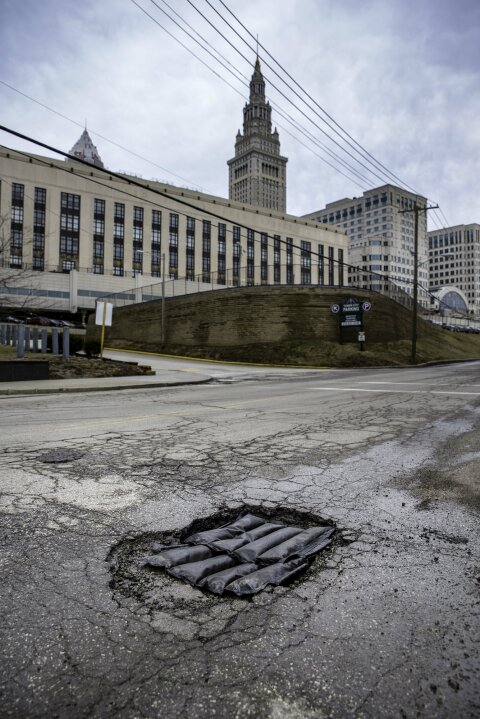
Case Western pothole patch - some updates

Source - link

We've been showing videos about the Case Western Reserve students who invented a better pothole patch for years in our summer camps and in our material science courses at Princeton.

I usually add the fact that most of those videos, however, are now a decade old, and I haven't seen the product being used. Thankfully one of my campers last summer took that as a challenge and went hunting for an update. 

Here's what he and I have been able to find...

  • Feb 2017 - Cleveland.com - "It has been more than five years since Okoye and three other students created the product, which received entrepreneurship recognition in 2012. Okoye said the idea never died, but attending college and finding a job while refining the product and seeking funding, took time." 
  • U-Patch Canada (YouTube) - 20 short, non-narrated test videos of the Thumper Pad in potholes, all from January 2018
  • Yeu Patch (Facebook) - No new posts since Feb 2019
  • KMBC.com - "KC uses thump pads as temporary fix to potholes" 
  • KMBC.com - The same story as above but as video.
There are a bunch of other, similar stories from those time periods, but the websites that the company website that I found - http://yeupatchtechnologies.com/ - doesn't seem to be registered anymore.

Monday, July 12, 2021

Repairing broken water mains

One of our regular activities in the corrosion chapter of our material science course is to read and listen to this NPR story about our corroding water mains and the costs that would be involved in repairing or replacing the parts of the network in need. I start the lesson by watching video of one of the more spectacular water main breaks that I've seen, the 2014 break on the UCLA campus.

This year the students asked what it took to repair a water main break like that. 

In searching, I couldn't find the repair work for that specific water main, but I did find a few other videos - including one from Skoakie, IL, the same city as the NPR story linked above.

Thursday, July 25, 2019

How To Stop a Colossal Bridge Corroding


Every year a trillion dollars are spent in the US (source) in dealing with corrosion (prevention, repair, research, down time, etc).

I'm glad Britain is spending a few dollars as well, particularly in keeping the bridges upright a little bit longer.

Here Tom Scott goes through the process of checking the cables of the Humber Bridge for corrosion ten years after a gigantic dehumidifier was installed for the air inside the cables.

Saturday, November 1, 2014

UCLA's water main break

So, California is in an historic drought. The water situation there is awful...AWFUL.

Check out this map of the state as of October 28, 2014 (sourced here)...


I mention this only because it makes the following video, of a ruptured, 30-inch water main break on UCLA's campus this past July particularly tragic and ironic.


According to an NPR story, the water main took 30 hours to shut off and lost 20 million gallons of water in the process.

As Infrastructure crumbles, trillions of gallons of water lost


My material science students read (and listened to) this NPR story this week, the day after I heard it on the radio. In her written response to the article, one of the students wrote that she was surprised that two water mains that far apart (I'd also shown video of a water main breaking on UCLA's campus this summer) could coincidentally break at the same time. I explained to her that water mains broke every day all around the country. I typed water main break into Google News and came up with hundreds of hits within the last couple of days.

Water mains break all the time. It's a cost of using metal pipes, that they will eventually corrode and crack and turn into pretty spectacular sinkholes and floods.

My students asked why we didn't just use something that wouldn't corrode, like glass.

Apparently I have some work to do when we get to the ceramics chapter.

Wednesday, August 13, 2014

Corrosion found inside the 520 Bridge pontoons


"Local news station finds corrosion in" random piece of infrastructure isn't exactly the hardest news story to go about finding. It involves checking any bridge, overpass, train tunnel, subway car, or...well...anything made of metal at all, pretty much.

It's just the natural order of things. Metals are just ceramic wannabes.


This article is interesting in that it's a floating bridge in Seattle, WA, and its supports...

from Wikimedia
...that get churning water and weather like this...

from wsdot - check out the waves just on the South side of the bridge

Thursday, July 31, 2014

Bridge to Classroom


My bridge didn't survive the magnitude 9.0 earthquake on the San Andreas fault. I'm not surprised about that, though, since Warren Zevon has been telling me to for years that California is going to slide into the ocean. I apparently helped a digital version to speed up that slide a bit thanks to Bridge to Classroom, an engineering simulation in which you (or your students) can test various bridge designs (beam girder, steel arch, cantilever-truss, suspension, and cable-stay) with a mixture of safety features (bearings, ductile materials, shock absorbers, and shear links) against earthquakes of eight different magnitudes after learning a little bit about the challenges presented in the San Francisco Bay.

Here's to hoping they built the real one better than my beam-girder/suspension/bean-girder model did.

Monday, July 14, 2014

Underwater Concrete Pouring


I don't think I want to go diving on those pylons, but I love that they're using the activity series right up front there to protect the steel cables in the columns. See, they make a weak battery, a weak battery, a weak battery where the zinc corrodes and prevents the steel from corroding.

That's got to be a whole lot of zinc being replaced on a pretty regular basis. I wonder how much zinc costs.

Thanks to Ryan Cox for sharing the video. As always, if you find any great videos, send 'em my way.

Sunday, June 29, 2014

Solar FREAKIN' Roadways!


This video has been making the rounds on Facebook of late, positing that much of the nation's energy problems could be solved by installing solar panels in the beds of roadways around the country, that we could install LEDs in the roadway to make the signage imminently changeable on a moment's notice. It feels obvious and has raised more than $2 million to fund the project.

...but is it really feasible?

The website Jalopnik has an article running the numbers, and their conclusion is that it's pretty well a longshot, a similar conclusion reached by the ExtremeTech website. From the ExtremeTech article...
With all that said, there’s still no denying that Solar Roadways are cool — but why not just, I don’t know, put solar panels along the side of the road? Or on the roof of your house? Or in the desert? Having built-in ice and snow melting is pretty neat, and lighting up when an animal steps on the road is cute, but neither are worth $56 trillion. Rooftop solar arrays are reaching the point where they’re actually quite cost effective in certain parts of the world — and they’re much, much cheaper than building a Solar Roadway — but adoption is still very low. As much as I’d love the US to be blanketed in green, fossil fuel-replacing electrified Solar Roadways, it just isn’t feasible. On the small scale, there could well be some companies that roll out Solar Roadway parking lots — but I think that’s about it, for the foreseeable future.