Showing posts with label history. Show all posts

Monday, January 5, 2026

How to Make a Warning Last 10,000 Years

Alan Wiseman's The World Without Us has a chapter titled "Hot Legacy" that explores our efforts to create warnings that will last at least 10,000 years into the future and will tell future archeologists that the interesting stuff they've found at some of our nuclear waste repositories should not be explored.

Much of the research is being done at the Waste Isolation Pilot Project is New Mexico, USA, and it's that work that SciShow details in today's video.

I remember that the Wiseman chapter also mentioned the placement of various magnets around the site as a warning that something was at least weird in this location. The video doesn't mention that, and I'm surprised because I found that one of the more interesting ideas.

Monday, December 29, 2025

How Japanese Masters Turn Sand Into Swords

This isn't a replacement for the Nova episode "Secrets of the Samurai Sword". 

...but the Nova episode tends to appear and disappear from YouTube and DailyMotion with fair frequency, so you might need another video that goes through the ancient art of creating samurai swords from the initial collecting and smelting of iron-rich sand through to the slicing of tatami mats to demonstrate the sword's quality and the sword wielder's technique.

This video's contents...

  • 2:00 - why bronze was used for sword and was eventually replaced
  • 3:00 - cyanobacteria creating oxygen that precipitated iron from ancient oceans
  • 6:30 - carbon + iron = steel, initial interstitial positions shown...why alloys are harder than pure metals
  • 10:30 - slag formation and removal from the 'ancient' forge
  • 13:30 - forging the steel by master swordsmiths
  • 14:30 - folding the steel - how and why
  • 16:15 - how carbon atoms migrate to different positions and form ferrite, cementite, perlite, and martensite
  • 18:30 - differential cooling rates via clay thickness creating different steel types and the distinct blade shape
Another great video from Veritasium and one that shows that he's got a team of folks making videos with/for him at this point...and it's short enough at about half an hour - to get through in a single class period, unlike the Nova episode.

Monday, June 10, 2024

Building a medieval castle from scratch

I assume these folks are using medieval techniques to build their castle because they want to not because they're just stubbornly French, right?

I remember in Thomas Thwaites's Toaster Project video that he mentioned needing to go further and further backwards in time when he wanted to bring the scope of industrial processes down to human-sized scales. If he wanted to smelt iron for a single toaster, he wasn't going to build an industrial blast furnace; he was going to find how they heated iron ore thousands of years ago.

That concept resonates as I see an ancient castle being built in modern times but with ancient techniques. They aren't looking for large-scale, industrial processes. They're looking for ancient craftsman methods.

If you want to see more, I'm putting a few more videos after the jump.

Monday, May 27, 2024

Science in an Art Museum, Part 1: The Science (and parts 2, 3, and 4)

As I mentioned last week, I toured the Indianapolis Art Museum's conservation lab as part of our summer ASM materials camp a decade or so ago. It was a great tour given by Dr Gregory Smith, star of this series of videos through which he explains the process of verifying the age and pedigree of an Uzbek Coat of Many Colors.

The rest of the four-part series is after the jump.

Monday, May 20, 2024

Lunch & Learn: The Science Behind Art, with the Indianapolis Museum of Art

Give 'em a break, alright?

It was the pandemic. People were trapped in their houses. They were doing their best to create content that was interesting and that could be enjoyed remotely.

No, a video of two people talking remotely to each other while narrating a slide show isn't necessarily the most exciting of presentations, but I can vouch for Dr Smith being an entertaining guy. He gave me and our summer ASM campers a tour of the Indianapolis Museum of Art's conservation lab about ten years ago, and it is one of the more unexpectedly great tours that I've been on through those summer workshops.

Take some time and see what Dr Smith has to teach us about art conservation and forgery detection today.

Monday, July 24, 2023

Not-so-turbo encabulators

I've posted about the turboencabulator before.

But since then I've noticed a glut of remakes of the turbo encabulator, so I figured I would throw them into a single post here.


More coming after the jump...

Monday, February 20, 2023

The history and future of Butte, Montana

I was lucky enough to teach one of our summer teacher ASM camps in Butte, Montana - at Montana Tech - the first time that city held such a camp. My time in Butte was great, and I am thrilled to have been able to visit Berkley Pit, a major feature in today's video.

This video is slightly about the history of Butte's mining industry but much more about the revitalization of the city's environment and the reclaiming of the environment around such a huge mining operation. 

There's a huge amount of clean-up to be done, but they've come a long, long way from a city surrounded by barren hillsides with the US's tallest free-standing masonry structure, one designed to spread the 75 tons of arsenic-laden dust produced daily a little further from the smelter. 

Monday, January 9, 2023

A Brief Scientific History of Glass


Source - https://glass.com.ng/glass-fact-history-glass/

Smithsonian magazine has a great article tracing both the history of glass and the modern scientific techniques used to reveal that history - everything from traditional archeology to radioisotope tracers to mass spectrometry.

Could be a really useful crossover between a chemistry and a materials science course, or just an introduction to a glass unit.

Monday, January 8, 2018

Why Roman Concrete Still Stands Strong While Modern Version Decays


Concrete, strong stuff...

But apparently Roman concrete is among the strongest stuff, and it just got stronger while it was under seawater.
Previous work had revealed lime particles within the cores that surprisingly contained the mineral aluminous tobermorite – a rare substance that is hard to make.

The mineral, said Jackson, formed early in the history of the concrete, as the lime, seawater and volcanic ash of the mortar reacted together in a way that generated heat.

But now Jackson and the team have made another discovery. “I went back to the concrete and found abundant tobermorite growing through the fabric of the concrete, often in association with phillipsite [another mineral],” she said.

She said this revealed another process that was also at play. Over time, seawater that seeped through the concrete dissolved the volcanic crystals and glasses, with aluminous tobermorite and phillipsite crystallising in their place.

These minerals, say the authors, helped to reinforce the concrete, preventing cracks from growing, with structures becoming stronger over time as the minerals grew.
And it looks like the Romans knew what they were doing.
As the authors note, the Romans were aware of the virtues of their concrete, with Pliny the Elder waxing lyrical in his Natural History that it is “impregnable to the waves and every day stronger”.
If you want to read more, check out the original research article...or the Guardian article that's way more readable and that I quoted up above.

Update: ...or check out a CNN article about the same research.

Wednesday, July 5, 2017

The History of Iron and Steel


I'll be right back. I'm going to refresh myself with the video Material Properties 101 before I watch the rest of this. Luckily, your friendly neighborhood blogger already linked to that video, too.

The video is a great exploration of...

  • the differences between wrought iron, steel, and cast iron
  • the processes in purifying iron ore - especially highlighting other videos that show primitive ways of doing this in modern times
  • blast furnaces, used to purify iron ore in modern times
  • producing steel in various ways - including via a puddling furnace
  • the Bessemer converter to produce steel

The video is, I think, too long to show in class unless your students have a better attention span - and tolerance for foreign accents - than mine do.

The video shows that it's 13:35 long, but it's really about ten minutes followed by a plea for a charity donation for the last three and a half minutes. The charity donation link is no longer accepting donations.

At 2:38 there's a hiccup in language. He says wrought iron is less than 0.8% carbon, but his graphic shows that it's less than 0.08% carbon. Wikipedia agrees with his graphic. Decimal places are hard sometimes.


Saturday, September 24, 2016

3D technology recreates 2,000-year-old monument


The video above cuts off a bit short of the full video found on the BBC's website.

It's fascinating here to see that an original monument has been recreated - or copied, really - in dispute of its destruction by ISIS (Daesh). 'Recreated' seems a little off to me because the original would have been made of stone blocks held together by mortar, but the new version is much larger blocks carved (CNC'ed really) to look like the smaller blocks are held together by metal rods through the center of each block.

Clearly, this isn't the original, but it's an interesting recreation.

Sunday, June 19, 2016

This is pure snow! It's everywhere! Do you have any idea what the street value of this mountain is?


So, the gag and some background.

XKCD is a webcomic. It's geeky and typically pretty outstanding. Sometimes, however, it's even better than that. Ever now and again Randall Munroe, XKCD's creator, expands the boundaries of the stories that he wants to tell, pushing beyond the limits of the standard three- or four-panel webcomic format.

In comic 1608, a glimpse of which is shown above, Randall published what looked like a single panel, coin-gathering game with the lead character on a hoverboard. If the player, however, ignored the 'rules' and headed outside of the game board, the world became much more interesting, including references to dozens of other XKCD strips, Star Wars movies, Lord of the Rings, and lots, lots more.

Somewhere to the left of the origin area was a Washington Monument, 'climeable' with your avatar's hoverboard. At the top of the monument was the scene shown above, with two characters climbing the Monument with conventional ropes and one of them commenting that the top of the Monument is solid aluminum, and they're going to be rich.

See, I get that because of my material science time and learning. I've posted about the Washington Monument's cap before, and the aluminum cap certainly would've been enough aluminum to make any man rich - when it was first installed.

I, as always, recommend XKCD in its entirety (though there are occasional NSFW moments). There's also a parallel website called ExplainXKCD.com for when you (or I) don't get the gags. You can also get a full-comic image of 1608 on ExplainXKCD, too.

The post title is also a gag for those of you in the know.

Thursday, March 31, 2016

The Harvard Library That Protects The World's Rarest Colors

Even if we go to the 152-crayon case from Crayola, there are certain colors that we just aren't going to ever get to, and I'm not just talking about blurple.

The chemical composition of colors - maybe pigments would be the better word - turns out to be important in identifying the veracity of recovered artwork. Certain pigments come into and out of fashion over the years, and pigments from paintings of already known provenance can be compared to the paintings of those of unknown provenance.

And there's a museum at Harvard University that keeps samples of more than 2500 historically-important pigments.

Monday, February 1, 2016

The history of the turbo encabulator

I'm not doing any original research here, folks, just duplicating information readily available in Wikipedia's article on the turboencabulator in case that information ever leaves the web.

From the article...

The original technical description of the "turbo-encabulator" was written by British graduate student John Hellins Quick (1923-1991). It was published in 1944 by theBritish Institution of Electrical Engineers Students’ Quarterly Journal [in an article titled "The Turbo-Encabulator in Industry" by "J.H. Quick, Student"[2] as also noted by consulting firm Arthur D. Little in a 1995 reprint of Quick's description, and giving Quick's full name.[3]
The earliest written U.S. source may have been in 1946, in an Arthur D. Little Industrial Bulletin. An early popular American reference to the turbo-encabulator appeared in an article by New York lawyer Bernard Salwen in Time on April 15, 1946. Part of Salwen's job was to review technical manuscripts. He was amused by the jargon and passed on the description from the Arthur D. Little pamphlet.[1]
Time got with the gag, featuring the device in a May 6, 1946 issue, described as "An adjunct to the turbo-encabulator, employed whenever a barescent skor motion is required."[4] A month later a response to reader mail on the feature appeared in the June 3, 1946 issue:
If the sackful of mail we have received from you is any indication, the story of "The Turbo-Encabulator in Industry" struck many a responsive chord. Aside from those of you who wanted to be reassured that TIME hadn't been taken in, we received the customary complaints about using too much technical jargon for the layman, observations such as "My husband says it sounds like a new motor; I say it sounds like a dictionary that has been struck by lightning"; suggestions that it "might have come out of the mouth of Danny Kaye," and plaintive queries like: "Is this good?" Wrote one bemused U.S. Navyman: "It'sh poshible." To some the turbo-encabulator sounded as though it would be a "wonderful machine for changing baby's diapers." A reader from Hoboken assumed that it would be on sale soon in Manhattan department stores. Many of you wrote in to thank us for illuminating what you have long wanted to tell your scientist friends."[5]
In 1962 a turboencabulator data sheet was created by engineers at General Electric's Instrument Department, in West Lynn, Massachusetts. It quoted from the previous sources and was inserted into the General Electric Handbook.[6] The turboencabulator data sheet had the same format as the other pages in the G.E. Handbook. The engineers added "Shure Stat" in "Technical Features", which was peculiar only to the Instrument Department, and included the first known graphic representation of a "manufactured" Turboencabulator using parts made at the Instrument Department.
In c. 1977 Bud Haggart, an actor who appeared in many industrial training films in and around Detroit, performed in the first film realization of the description and operation of the "Turboencabulator", using a truncated script adapted from Quick's article. Bud convinced director Dave Rondot and the film crew to stay after the filming of an actual GMC Trucks project training film to realize the Turboencabulator spot.[7]
In c. 1988 the former Chrysler Corporation "manufactured" the Turboencabulator in a video spoof.[8] Rockwell Automation"manufactured" the renamed Retro-Encabulator in another video spoof in c. 1997.[9] On April Fools' Day 2013, Hank Green released a SciShow episode on YouTube entitled "The Retro-Proto-Turbo-Encabulator."[10]

Here are scans of the original Quick article...

...and the GE Handbook...


Sunday, September 6, 2015

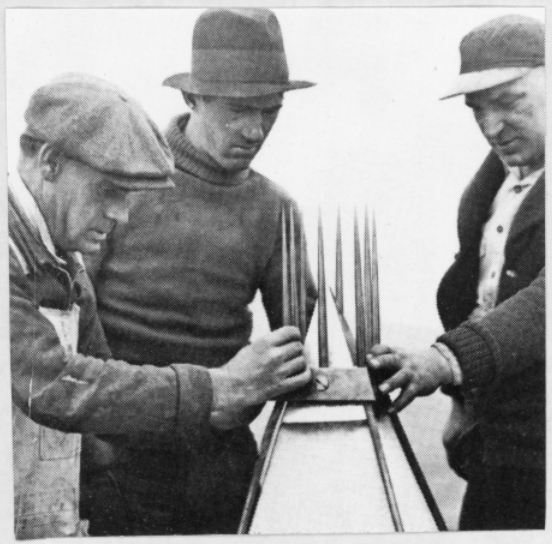
The Point of a Monument: A History of the Aluminum Cap of the Washington Monument


The Washington Monument was capped with aluminum in 1884 because aluminum was among the most valuable metals at the time, and the use of aluminum as an apex for the monument was a way for the United States to demonstrate its material science and industrial primacy in the world.

At least that's the story I tell in my material science class and in my summer workshops.

George Binczewski, however, tells a different story in his article "The Point of a Monument: A History of the Aluminum Cap of the Washington Monument." In the article, Binczewski recounts the story of how aluminum was chosen, cast, and subsequently refurbished. Apparently aluminum was not the first choice, and material selection had more to do with use as a point to the lightning protection system.

That isn't nearly as exciting a story as the mic drop version of material science. "We have aluminum. You don't. Deal with it, punks. US out."

Sadly, though, it just might be truer. I'm going to have to adjust my patter again.

By the way, you can check out the aluminum apex actually looks - as of the Monument's 2013, post-earthquake check-up, anyway - in this pic (source: Wikipedia).


And here's a look at the most metal version of the apex in its era of having a copper jacket (visible just above at the base of the apex) but without its temporary copper spikes to further its job as a lightning rod. (Source: Phillip C Marshall)


Pic up top is from Red Ice Creations.

Wednesday, August 12, 2015

Edisto Island, South Carolina and Alexander Bache's

My wife and I took a trip to Edisto Island, South Carolina this June, camping a couple of miles from the beach in a rented, teardrop camper. The campsite adjoined Botany Bay, a plantation-cum-nature-preserve with gorgeous beach access.


In hiking Botany Bay's grounds, just past the Bleak Hall Ice House, we followed a sign for the Bache monument, neither of us having any idea what the Bache monument was - or how to pronounce Bache. After a fair number of twists, turns, spider webs, and uncertain left and right turns, we came upon a two and a half foot tall, four-sided, low-slope peaked granite monument inscribed with the name Bache and a few other things that meant nothing to us.

Heck, we didn't even take a photo, the monument was so uninteresting and unassuming.

Until we hiked through Edisto Beach State Park the next day, finding ourselves at the education center in the far, western edge of the park. There we found a second Bache monument, thankfully along with educational placards explaining just why that unassuming granite tower was remarkably important and interesting.

I'll start with the informational placards then follow up with my explanation and interpretation.


Sunday, May 3, 2015

This 1,600-Year-Old Goblet Shows that the Romans Were Nanotechnology Pioneers


The Romans were genius.

The had the baths, the vomitoria, the toga parties, the aquaducts, the fingers.

And they had goblets that change color as light went through them and as different liquids are filled into it. In fact, the science is pretty stunning...
researchers in England scrutinized broken fragments under a microscope and discovered that the Roman artisans were nanotechnology pioneers: They’d impregnated the glass with particles of silver and gold, ground down until they were as small as 50 nanometers in diameter, less than one-thousandth the size of a grain of table salt. The exact mixture of the precious metals suggests the Romans knew what they were doing—“an amazing feat,” says one of the researchers, archaeologist Ian Freestone of University College London.

...

[T]he researchers ... imprinted billions of tiny wells onto a plastic plate about the size of a postage stamp and sprayed the wells with gold or silver nanoparticles, essentially creating an array with billions of ultra-miniature Lycurgus Cups. When water, oil, sugar solutions and salt solutions were poured into the wells, they displayed a range of easy-to-distinguish colors—light green for water and red for oil, for example. The proto­type was 100 times more sensitive to altered levels of salt in solution than current commercial sensors using similar techniques.
Clearly, the lead hadn't kicked in just yet when these goblets were being made.

Monday, July 21, 2014

Rich Earth and ASM Historical Landmarks

I check a number of blogs with some regularity, and most never get a mention here because they tend to head far more toward the realm of internet curios than they do toward the world of material science.

Occasionally, however, serendipity helps me out, and one of those blogs provides something for me to post here. Today was one of those serendipitous days as the Futility Closet blog has a short post on the historical origins of ytterbium, yttrium, terbium, erbium, holmium, gadolinium, and thulium, all discovered from the same mine near Ytterby, Sweden.

That's cute and all, but what really caught my eye was the included image (sourced from Wikimedia Commons) of the ASM Historical Landmark plaque - assumedly from somewhere near the mine.


I had no idea that ASM had a serious of historical landmarks, but now that I do, I think I may have a few field trips in my future as five of them are within less than an hour's drive of my home near Cincinnati, OH.

Monday, July 14, 2014

Dissolve My Nobel Prize! Fast! (a true story)

One of the most fascinating stories of the activity series (because there are so many, donchaknow) is that of the dissolving of two Nobel prizes (the gold medallions themselves) in a desperate rush as the Nazis marched into Copenhagen an 1940. The story involved aqua regia - a mixture of hydrochloric and nitric acids - and the heroic efforts of George de Hevesy.

The most heart-warming part of the story, then, is that de Hevesy was able to return in 1950 and recover the gold, which he then had reminted by the Nobel Prize committee for eventual presentation back to the original award winners in 1952.

The story is published by NPR who quote Sam Kean's The Disappearing Spoon.

Thursday, July 4, 2013

Concrete: A slightly tongue-in-cheek look


That's a big piece of sewer pipe. It's kind of weird that it's in sharper focus than is the rest of the frame, though.

The Engineer Guy makes some concrete - apparently from quickcrete - and then waits for it to set while his sample cures.

At 1:45 he says that concrete doesn't really dry and explains what's really happening. Then, though, at 2:05 he says he's going to wait for the concrete to dry. Sheesh...